Written Form: What Makes a Signature Valid

Written Form
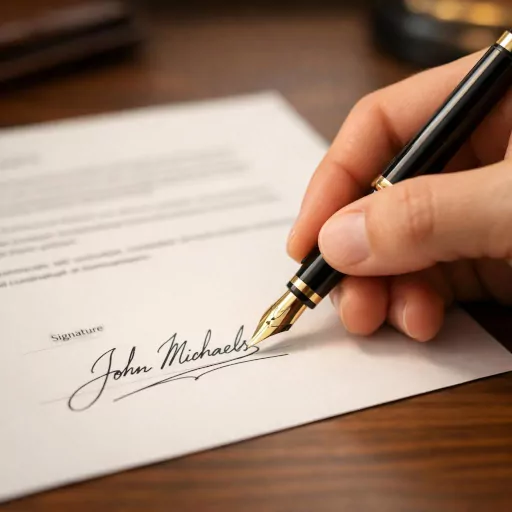
“I haven’t signed anything” – I hear this often. But most contracts do not require a signature or any particular form. The BGB starts from the principle of freedom of form. An oral contract is still a contract; it is just difficult to prove.
For expats: This surprises many people from common law countries, where certain contracts must be in writing to be enforceable (think the Statute of Frauds). German law is generally more flexible, but the exceptions matter – and the consequences of a formal defect can be the contract being void.
Written Form vs. Text Form
Written form (Schriftform) means a handwritten signature on paper, § 126 BGB. An ordinary email does not satisfy this. A fax without a signature does not either.
That is why the legislature added text form (Textform) as a less demanding alternative: the content must be legible and the author identifiable, § 126b BGB. An email or a screenshot of a message suffices.
If a contract requires “written form” and you terminate by email, the termination may be ineffective.
Electronic Signatures
Written form can be replaced by a qualified electronic signature (QES), § 126a BGB. A scribble on a smartphone or a scanned image of a signature is not enough. The requirements are set out in the EU eIDAS Regulation: a QES requires prior identity verification – video identification, PostIdent, or in person. Only a small number of providers actually offer this, and they must appear on a list of approved providers.
The QES Problem
Many signature services market themselves as a “legally secure digital signature” without disclosing whether they provide a QES. Most provide only an advanced electronic signature.
An advanced signature is of course “legally secure” – but only where no written form is required. Where only text form or no form at all is needed, a phone scribble causes no harm and in that sense is “legally secure.” But for contracts that require written form by statute, you need a genuine QES. Employment contracts, for instance, must be in writing – a digital signature does not work for those.
Anyone who believes they have validly signed a guarantee or a consumer loan agreement digitally may be mistaken – if the provider does not actually deliver a QES, the contract may be void. In a dispute, that often turns out to be an advantage.
Curing a Formal Defect
A formal defect does not always make a contract permanently void. In some cases the law provides for cure – when the contract is actually performed despite the formal deficiency. A consumer loan agreement, for example, is cured by disbursement and drawdown of the funds. Whether and how a formal defect can be cured depends on the type of contract.
Notarial Authentication
Some contracts require more than a signature – they must be notarially authenticated. Real estate purchase agreements, GmbH incorporations, transfers of GmbH shares, and inheritance contracts all fall into this category. Without a notary, there is no valid contract.
Contact:
He has 266 google-reviews
Rating: 5,0 ⭐⭐⭐⭐⭐